


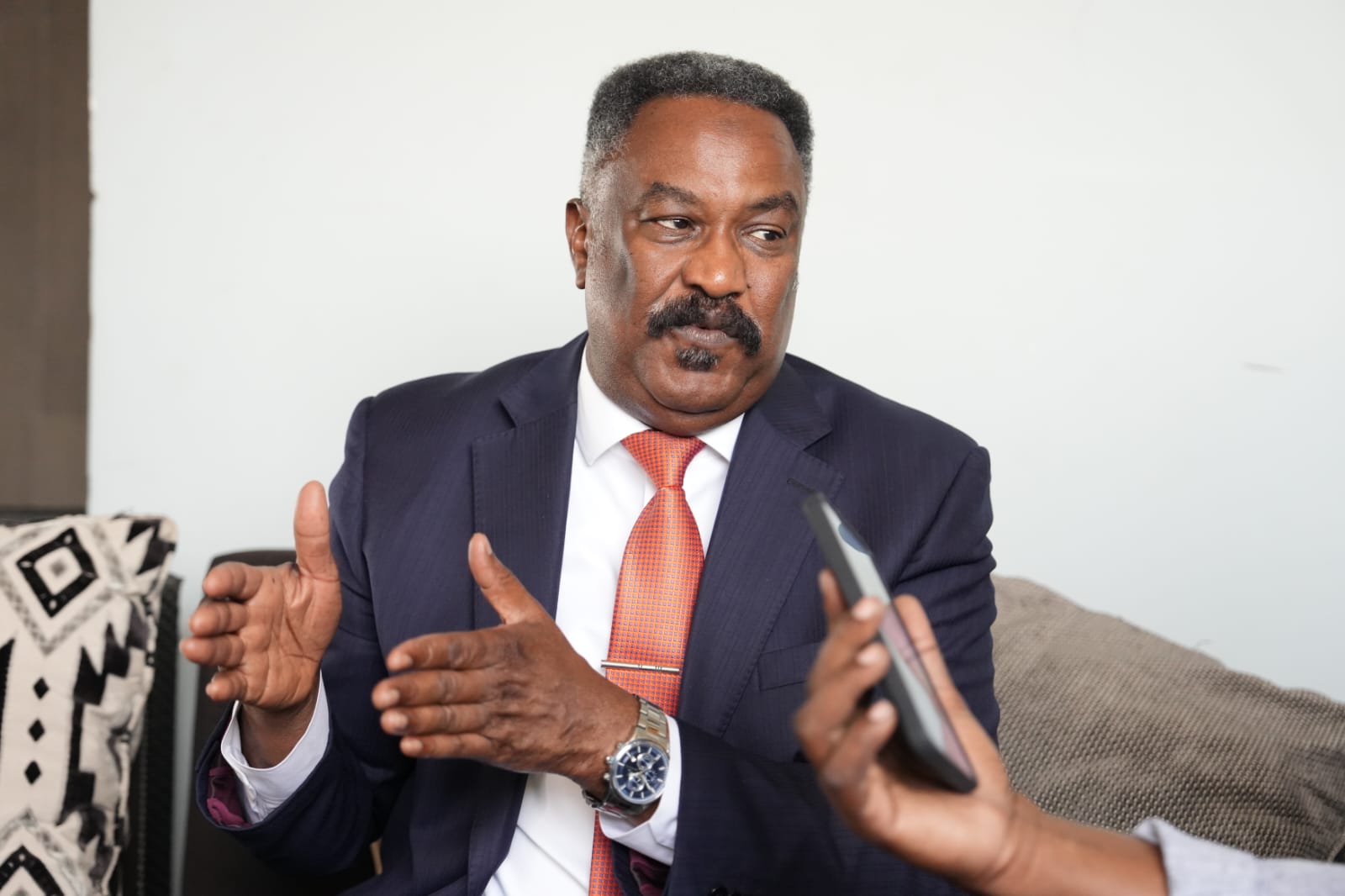
In a Candid Interview, The Prominent Leader in (Tasis), Makin Hamid Tirab:
The Sudan Founding Alliance Redefines Sudanese Politics: Between War and Peace
“We have established supra-constitutional principles that ought to preempt coups indefinitely”
An unprecedented consensus on the concept of a Secular State is Achieved
“Al-Kizan” lost the battle… and the international community is holding its doors open to the Peace Government
The General Rapporteur of the Sudan Founding Alliance (Tasis), Makin Hamid Tirab, boldly uncovered the features of an odyssey of political struggle spanning a period of time that exceeded three decades, following the (April 1985) uprising.. to the announcement of the Peace Government. Makin took the time to share his experiences as part of the opposition abroad, in addition, he discussed the motives and reasons behind establishing the new Alliance as a response to the complex national reality. In an exceptionally candid interview with (Tasis) Newspaper, he shared that Sudan needs a new political project that combines civil and military action in an effort to address the roots of the crisis. Additionally, he highlighted the numerous challenges the Alliance faced; from international recognition to resources, he emphasized that (Tasis) managed to successfully establish a Constitution and Charter -unprecedented in the country’s history, representing the foundation for a State of justice, citizenship, and the unity of Sudanese territory.
Makin is a leader who was blessed with the fate of accumulating experience through numerous tests, refined by struggle, until he reached the intellectual conclusion that there is no alternative to the founding process… And that is precisely how our interview with him commenced. The following are the minutes of the interview:
Preliminary Insight:
Makin, the General Rapporteur of the Sudan Founding Alliance, shared at the beginning of his statements: “The struggle —and by no means do i intend to solely focus on strife— began at an early date, since our days at Cairo University. We were amongst the first to participate in the (Rajab/April 1985) uprising, and then we joined the Union of Uprising Forces. Three months prior to the ill-fated coup of the National Congress Party (NCP), I left Sudan, and my departure continued for more than thirty years, the lifetime of the Salvation (Inqaz) Regime itself. Throughout this particular period, we embarked on our journey of struggle against the Salvation Regime and the National Congress Party, moreover, we founded the National Democratic Alliance in the Gulf, based in the Kingdom of Saudi Arabia (KSA).”
He continued: “Our stance throughout the Gulf War was honorable and significant. For we preserved the gains of the Sudanese people, in addition, the struggle continued until we established the Sudanese Community, which encompassed all political forces, including the Popular Movement as well as the Armed Struggle Movements. At that time, this particular model was one of the largest national alliances that led the opposition movement, and it continued putting forth diligent efforts for three decades, during which we were able to completely neutralize the Sudanese Embassy in Riyadh.”
Furthermore, Hamid Tirab explained: “Until the glorious December Revolution took place, we, through the Sudanese Cultural Center, were amongst the biggest supporters of the revolutionaries inside Sudan. I did not leave prison until more than a month following the fall of the deposed president Omar Al-Bashir, it constituted a rather lengthy journey, during which we commended the freedom fighters who upheld the banner of freedom and dignity.”
“Following the fall of the regime, I was blessed with the opportunity to return home and was appointed in (2020) to head the Overseas Workers’ Agency. I continued to perform my duties until the outbreak of the ongoing war. Nevertheless, mere hours prior, I had left on an official mission to the Kingdom of Morocco due to issues related to the Agency’s duties. I was accompanied by the undersecretaries of the Ministries of Justice, Interior, Foreign Affairs, the Council of Ministers, and Forensics. However, following the outbreak of the war, I did not return to Sudan and was officially dismissed, which, in turn, heralded the onset of a new phase of struggle to end the war.”
In regards to the reasons for which the Sudan Founding Alliance was established, Makin stated: “The path adopted by the national movement in Sudan is rather taxing and thorny, in addition, the challenges of the national reality are extremely complex. The political alliances’ experience throughout Sudanese history has -unfortunately- garnered limited successes, whilst failures have been prevalent, starting with the National Democratic Alliance, followed by Sudan Call and the Revolutionary Front, and finally (Tagadom).”
The General Rapporteur of (Tasis) further remarked: “When the Coordination-body of the Democratic and Civil Forces (Tagadom) was announced, naturally, that particular development invoked a significant amount of hope that it would embody a new model, especially since its beginnings were far from lacking. Indeed, its leaders met with the Rapid Support Forces (RSF) in understandings in Addis Ababa. The aforementioned meeting was not the first of its kind; as the Rapid Support Forces was -previously- in consensus with them in regards to the Framework Agreement. Nevertheless, the same agreement was the direct cause of the outbreak of the ongoing war, as a result of the Sudanese Armed Forces’ refusal and intransigence, compound with the latter’s alignment with the Islamists’ position (Al-Kizan), rejecting the Framework Agreement and threatening war during their Ramadan iftars and organizational meetings.”
Makin Hamid Tirab went on to share: “If we were to contemplate the trajectory of the ongoing war in Sudan, we would find that the Rapid Support Forces continued to extend their hand in peace throughout, whilst the Sudanese Army and the Islamists (Al-Kizan) intransigently ignored all initiatives with a single, recurring phrase: ‘Bal bas, i.e; Military decisiveness only.’ Therefore, it became rather necessary to create a new reality that combines political and military action into a single path.”
“Nonetheless, we knew as well that large segments of Sudanese society were left bereft, completely excluded by the State, after their people were stripped of their sense of belonging to the homeland and deprived of their most basic rights: education, health, services, and even the ability to obtain identification documents. Furthermore, Communications and electricity were cut off, their currency was replaced, and they were targeted with excessive violence using warplanes that indiscriminately destroyed villages, pastures, and homes,” according to Makin.
He added woefully: “The world was appalled to witness a State using its lethal force to destroy its civil infrastructure and crush its citizens with such malicious brutality. All these crimes forced us to contemplate the facts differently. For when we were part of (Tagadom), we realized that the current path would fall short of achieving change, hence, we collectively decided on the necessity of establishing a government that takes into account the interests of the affected communities.”
According to the Alliance’s General Rapporteur: “In addition to national motives, there were regional and international motives as well, that we sought to discuss clearly. Over the past three decades, the Sudanese people have -unfortunately- paid a heavy price for the violations committed by the Islamist regime and the terrorism it exported to the world, to the point that Sudan came to be viewed as a threat to regional security. Therefore, the Founding idea emerged as a national and regional necessity.”
Makin pointed out that one of the national motives was the unjust laws that deprived citizens of their inherent rights simply because they were present in areas controlled by the Rapid Support Forces, most notably of which is the so-called “Strange Faces Law.”
He questioned rather vehemently: “What fault did the citizens residing in those areas commit that they should be deprived of their legal and constitutional rights? Consequently, a new reality proved to be a necessity, one that would grant them justice and restore their status as full citizens.”
“Apropos of the regional and international motives, it is clear that the Sudanese people have paid a heavy price over the past three decades due to the policies adopted by the Islamist regime and its involvement in supporting extremism and terrorism. In consequence, Sudan has become, in the eyes of the world, a source of crises and a real burden on regional and international security. Hence, the founding reasons were in response to the urgent need to build a new Sudanese State, reconciled with itself and with its surroundings,” according to the speaker.
He added: “We were in consensus in regards to this vision, and we were faced with three major challenges from the outset:
Firstly, The international recognition of the legitimacy of the new government.
Secondly, The manner in which we could secure the necessary resources to govern the State.
Thirdly, The concerns regarding the possibility of division.”
Furthermore, with reference to the appropriate course of action to address the aforementioned challenges, Makin remarked: “We, who supported the establishment of the government, believed the exact opposite, which prompted us to take the time to cogitate and search for realistic solutions. We engaged in serious and intensive dialogues, furthermore, we began drafting the Founding Charter with the participation of various parties, including the Civil Democratic Alliance of Revolutionary Forces (Sumoud), as a number of the Alliance leaders provided handwritten contributions to the draft charter.”
He continued: “However, ultimately, some parties stalled at specific points related to resources, recognition, and the valid concerns about division. For our part, we believed that the matter was serious enough and naturally deserved its fair share of diligence and progress. By the grace of the Almighty, we were able to lead dialogues with various Sudanese political forces, most notably of which is the Sudan Liberation Movement, led by Comrade Abdul Wahid, along with civil society components and professionals as well. This was the first time in Sudan’s history that a thorough and clear discussion was initiated in regards to the core issues, in which we managed to successfully overcame all the historical phobias that had shackled our country for decades.”
Additionally, Makin emphasized that the referenced discussion covered all the issues that the Sudanese people have been avoiding -rather diligently- for more than seventy years, adding: “We chose to boldly discuss the issue of State Secularism and reached an unprecedented consensus on the subject. Surprisingly, some of those who refused to join the Sudan Founding Alliance for social or personal reasons later acknowledged that the Alliance’s Constitution and Charter were unprecedented achievements in Sudan’s history since the State’s independence, and perhaps this particular development will never be repeated, because it provided radical solutions to all historical problems within the context of the State’s structure.”
In conclusion of his remarks on this particular subject, he shared: “We have established the foundations of a new Sudanese State, a State of justice and citizenship, and we have managed to establish supra-constitutional principles that ought to preempt the recurrence of coups indefinitely. One of the politicians who now supports (Sumoud) even asked me, wondering, ‘An unprecedented step has been achieved… why shouldn’t I join?’ My response was, ‘This is exactly what we want —for everyone to come together to achieve something unprecedented.'”
“The Sudan Founding Alliance (Tasis) has met the aspirations of Sudanese patriots, and we ought to excuse those who have yet to join for non-political reasons, nevertheless, I am certain they will soon join the bandwagon. For today, we receive countless requests from groups, individuals, parties, and institutions wishing to join, because the Founding Alliance laid the foundation for a healthy nation that accommodates everyone.”
Makin went on to add: “The greatest achievement -to date- is the joining of our brothers in the Sudan People’s Liberation Movement-North (SPLM-N), led by Abdelaziz Al-Hilu. We have thus successfully overcome the stage of estrangement and achieved a degree of consensus beyond all expectations.”
For his part, Makin emphasized that at this juncture, the Alliance is proceeding with its efforts in a harmonious and agreeable atmosphere, noting that the trust achieved in just one year is an unprecedented achievement, as he went on to add: “We are functioning harmoniously and with great responsibility, in addition, we are keen to protect the historical bloc that has been formed, because what (Tasis) has magnanimously achieved represents a true expression of the will of the Sudanese people. Hence, we blatantly emphasized in the Charter the unity of Sudan, its land and its people.”
Moreover, Tirab stated: “Currently, the Alliance has a clear roadmap for addressing the Sudanese crisis and is putting forth diligent efforts to formulate a comprehensive vision for a just peace, which has already been presented to regional and international powers. Its a comprehensive and disciplined vision to address the roots of the historical crisis in Sudan, furthermore, these are unprecedented efforts.”
In reference to the international position -the international community’s interaction with the new government, Makin chose to state: “Initially, we were confronted by a major campaign of disruption led by the Islamists (Al-Kizan), who still possess numerous fronts supported by a number of countries and international Islamic organizations. Moreover, let’s not forget that during their thirty years of rule, they were allowed the opportunity to built extensive networks of relationships fueled by bribery and astonishing corruption, through which they established public relations offices in several capitals in order to influence regional and international public opinion.”
He continued: “This reality, in our early days, made it very difficult for us to communicate with the international community, especially since the Sudanese Army held a bleak image throughout its history. As it never fought a war against an external enemy, but rather all its wars were against its own people —from South Sudan to the Nuba Mountains and Blue Nile, all the way to the suppression of protesters in the streets.”
Makin concluded his statements by sharing: “Nonetheless, following the announcement of the Sudan Founding Charter and Constitution, which prompted the formation of the Peace and Unity Government, the situation changed drastically. For doors were then held open welcoming us, and the international community began to understand our cause more thoroughly, in addition, we had the opportunity to meet with all regional and international envoys, and clearly explained our vision to them. Today, the Peace Government is operating in a positive atmosphere, and we have managed to successfully deal a devastating blow to the Islamists’ project, which has long continued to thrive on chaos and division.”
